
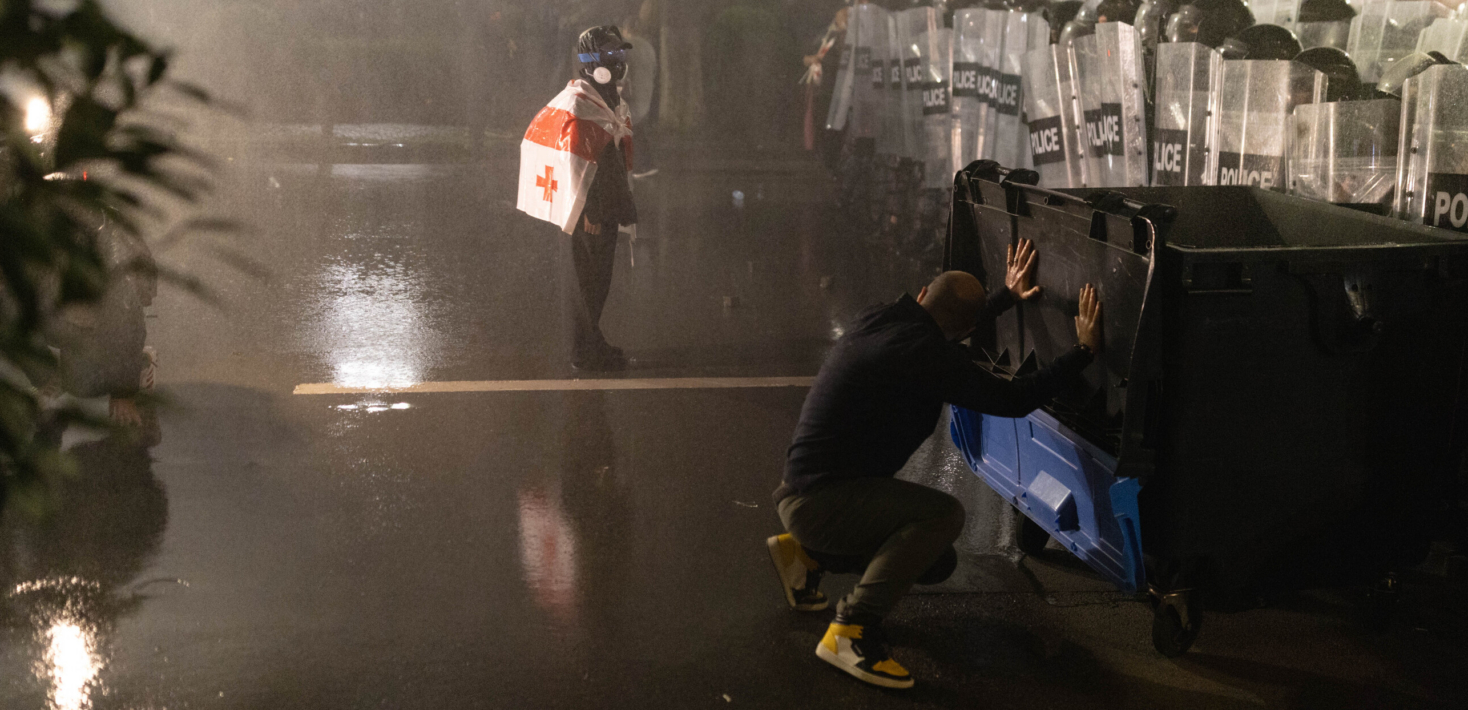


Ahead of the second anniversary of the start of the ongoing anti-government protests in Georgia, which have been marked by persistent human rights violations and near-total impunity for those responsible, Denis Krivosheev, Amnesty International’s Deputy Director for Eastern Europe and Central Asia, said:
“After two years of escalating government repression, few areas of public and political life remain untouched. From taking steps to outlaw opposition parties and dismantle civil society at large, to the targeting of hundreds for taking part in protest, repression is now deeply woven into the fabric of Georgian society.”
“Artistic expression and political satire are under attack. Musicians have been threatened and fined over protest songs, journalist have been detained over satirical posts, and comedians have been assaulted for making jokes, in an atmosphere or violence spearheaded by the state. What began as a crackdown on street protests has become a daily assault on fundamental rights and freedoms.
“Justice for police violence remains elusive, emboldening further abuses, and the recent release of protesters, and convictions of a handful of police officers for abusive use of force, cannot disguise the scale of continuing injustice, with dozens of people including Mate Devidze still in prison following unfair trials.
“The authorities must investigate allegations of torture and other ill-treatment and bring those suspected of responsibility to justice. They must immediately release everyone imprisoned solely for exercising their human rights and ensure an independent review of all protest-related convictions.”
Justice for police violence remains elusive, emboldening further abuses, and the recent release of protesters, and convictions of a handful of police officers for abusive use of force, cannot disguise the scale of continuing injustice
Denis Krivosheev, Amnesty International’s Deputy Director for Eastern Europe and Central Asia
Background
Since the protests began in November 2024, after disputed parliamentary elections and the freezing of EU accession talks, thousands have faced arbitrary detention and fines, hundreds have reported torture or other ill-treatment, and over 150 individuals were imprisoned after unfair, politically motivated trials.
The intimidation campaign continued to target dissent: musicians Kordzi and Sofo Batilashvili were threatened and fined over protest songs; journalist Vakho Sanaia was twice detained over satirical posts; comedian Onise Okriashvili was assaulted near his home by unknown individuals after a government-encouraged smear campaign. Recently, activist Tornike Razmadze faced threats and smears by pro-state media through AI-generated videos falsely portraying him as a drug dealer.
Over 300 protesters reported torture or other ill-treatment during the November-December 2024 crackdown alone. Only five low-ranking police and special forces officers have been convicted, and no one in command is known to have been charged. In September, activist Sergi Kancheli reported being beaten, threatened at gunpoint and subjected to attempted sexual violence by six police officers. No officers are known to have been charged over these allegations. Allegations of unlawful toxic chemicals used against street protestors also remain without effective investigation.
On 23 November, seven convicted protesters were granted pardons. Previously, in August, nine others were released. On 12 and 16 November, five police officers were sentenced to up to five years in prison for beating protester Zviad Maisashvili, Formula TV journalist Guram Rogava and opposition politician Levan Khabeishvili. Further investigations involving at least 167 victims failed to yield any results.